

Step 1
DETERMINE THE VENT LOCATION
• Choose a location on the roof that is directly above the dryer’s exhaust line. The vent should be placed between two rafters for proper support.
• Ensure the dryer vent is positioned typically in the second or third course below the ridge, ensuring it’s not in an
area of concentrated water runoff.
• Turn up a minimum of 1” to create a water diverter, ensuring water-shedding capabilities.
Step 2
PREPARE THE ROOF OPENING
• From the attic, use a drill bit to mark the center of the desired vent location. This will give you a reference point
on the roof’s exterior.
• On the roof, use the vent’s collar as a template to trace a circular opening (4” round). The opening should be slightly larger than the vent pipe’s diameter to allow for a snug fit.
Step 3
INSTALL THE DRYER VENT
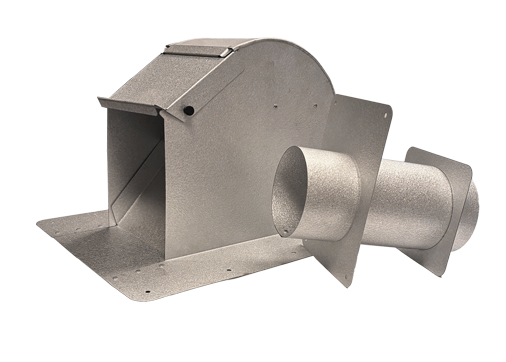
Place vent so that inner tube attaches to attic tube.
• Lower the galvanized steel vent into the prepared opening, ensuring the vent pipe passes through the hole.
• Orient the vent so that the flashing’s highest point is “uphill” and the flange rests flat against the tile.
Step 4
SECURE THE FLASHING
• Once the vent is properly seated, secure the flashing to the roof deck using galvanized roofing nails.
• Place a nail in each corner and then space additional nails every 6 inches along the perimeter of the flashing.
Crucial Step: Apply a generous amount of roofing sealant.
Step 5
TILE INTERGRATION
• Place the tiles: Install the roof tiles around the vent, leaving a space for the vent’s top cover. The top cover is
designed to take the place of two field tiles.
• Trim tiles if necessary: You may need to trim the tiles to ensure a proper fit around the vent. This is often the case with tile battens or lugs.
• For metal roof applications, consult the metal panel manufacturer flashing specifications.
Step 6
TOP COVER AND FINAL SECURING
• Install the top cover: Slide the vent’s top cover into position. The lower lip of the top cover should slide under the
adjacent tiles.
• Secure the cover: Secure the top cover to the roof deck using approved fasteners. Some vents have fastening
straps or wind clips that you’ll need to secure.
• Seal: Use proper safety equipment, including harness and fall protection, when working on a roof.